To top or not to top: comparing chemical and sensory properties of wine aged with monthly topping vs. wine aged in sealed barrels (2022)
Matthieu Finot
King Family Vineyards
Summary
One drawback of aging wine in oak barrels is the evaporation of wine leading to the need for frequent topping. In some regions, barrels are sealed and turned rather than topped, limiting the personnel time spent on topping. In this experiment, four barrels each of four lots of wine were used to compare the overall effect of topping compared to sealing on volume loss, oxygen ingress, and SO2 depletion. After the completion of malolactic fermentation and addition of SO2, all of the barrels were topped and sealed with a silicon bung. For each pair of barrels, one barrel was topped monthly while the other was turned by 45 degrees and left sealed for the duration of the aging period. At the end of 6 months, wine chemistry, total volume loss and sensory characteristics were nearly the same between treatments. There was no clear advantage or disadvantage to topping vs. sealing and turning barrels. If barrels are tightly sealed, do not need to be sampled frequently, and contain sufficient free SO2, sealing and turning barrels may be a labor-saving approach to wine aging.
Introduction
Wooden barrels have been used for wine production and storage since antiquity. Egyptian hieroglyphs and tomb paintings portray the use of wooden barrels, though their contents may or may not have been wine. The Greek historian Herodotus (485-425 B.C.) reported the transport of wine down the Euphrates River in palm wood containers while Pliny the Elder (23-79 A.D) described wine being stored in wooden vessels with hoops in regions north of the Alps. By the 4th Century A.D., wooden barrels were in wide usage for wine storage and transport throughout Italy.1
In modern times, oak barrels are in near ubiquitous usage for the aging of most red wines and are also used in fermentation of some white wines. Over time, wine drinkers have come to appreciate the effects of oak aging, including color stability, wine clarity, oak flavor, and tannin polymerization.2 Despite the benefits of using oak barrels for wine production, barrels also present challenges for winemakers. New barrels are expensive, currently costing over $1000 each. They require special cleaning to prevent microbial spoilage and maintenance to prevent leaking. They also impart flavors that may have positive or negative impacts on the wine. Though barrels are available in many different sizes, the most common size in use in Virginia cellars are Bordeaux style barriques and Burgundy style pièces. These hold 225L (59 gallons) and 228L (60 gallons) respectively. This size vessel may have initially been developed so that one man could handle the barrel on his own, or because they contained a convenient volume of wine for shipping.2 However, the small size of barrels relative to tanks leads to reduced production efficiency as each barrel must be filled, monitored, and topped individually.
Unlike stainless steel tanks, barrels are active vessels,3 with several processes contributing to a dynamic physical and chemical environment for wine as it ages. As soon as an oak barrel is filled with wine and sealed with a bung, several processes begin in tandem. Barrel staves soak up about 5 liters of wine within the first few days of barrel filling,2 a process that continues at a slower rate for about 40 days.3 Liquid also evaporates through pores in the barrel staves and through gaps in the seams between staves and around the bung.2,3 The rate of evaporation depends on cellar humidity (80-90% humidity is best), the amount of air movement (more movement leads to more evaporation), and the amount of temperature variation (causing expansion and contraction). In low humidity cellars, water evaporates faster than ethanol, leading to the concentration of alcohol in the wine. The opposite trend occurs in cellars with high humidity. Characteristics of the oak itself, such as grain size and even the growing conditions of source forests. Used barrels are less porous than new barrels.2,3
As water and ethanol exit the wine, oxygen enters the wine through air pockets in the cells of the oak. French oak is more permeable to oxygen than American oak due to differences in the anatomy of the wood itself. Most of the oxygen transfer into wine occurs in the first years of oak aging with an estimated 40 ml entering a 250 mL barrel in the first year vs. 30 mL in the second year.3 This slowing of oxygen diffusion is mostly due to a moisture barrier that forms where wine has permeated into barrel staves. Ellagitannins in oak may also bind oxygen at this interface, further decreasing the amount of oxygen entering the wine by permeation.3
As liquid water and ethanol leave the barrel over time, a gaseous headspace forms in the barrel. This headspace will form regardless of whether or not the barrel is tightly sealed with a bung. However, the characteristics of the headspace will differ depending on the condition of the seal. In a sealed barrel, the initial buildup of negative pressure inside the barrel due to evaporation draws the barrel staves closer together, essentially shrinking the volume of the barrel.3 Eventually the physical limit of barrel contraction will be reached and a headspace will form at the surface of the wine. The force of the vacuum will pull dissolved gasses from the wine itself such that the composition if the headspace will reflect the proportion of gasses in the wine. Del-Alao-Sanza and Nevares (2018) measured the headspace gas composition in sealed barrels to be 28% CO2 and only 1.8% O2 (with the remaining portion mostly nitrogen). If the bung has not formed a tight seal, evaporation of water and ethanol will pull air from outside the barrel into the headspace, with a much higher influx of oxygen. The headspace in this case is compose of 5-9% O2 and 20% CO2.3
Del Alamo-Sanza and Nevares (2018) summarize these processes well when they say:
“Oxygen entry into the barrel occurs throughout aging in a dynamic manner and there are several factors determining this entry that are all directly related. Of these, it is necessary to emphasize wood impregnation, the formation of reduced pressure inside the barrel, the type of seal, the wood, and the toasting performed in the cooperage.”3
Regardless of its origin, oxygen in the headspace during wine aging allows acetic acid bacteria to proliferate and produce acetic acid and ethyl acetate.2 To counter this threat, winemakers limit oxygen in the headspace by topping and/or sealing barrels. When topping, wine of good quality, free of microbial contamination, and of low dissolved oxygen should be used to refill the headspace in the barrel. The topping operation involves removing the bung, which floods the headspace with air. This air is quickly displaced by wine, but the operation is estimated to add 4 mg/L oxygen overall to the wine stored in barrel,3 constituting about 50% of the oxygen addition in a given year.2 Depending on the desired amount of oxidation, Ribereau-Gayon et al (2006) recommend topping as frequently as two times per week or as seldom as once every 2 weeks. In practice, many Virginia wineries top once per month due to personnel constraints. Given the fact that oxygen is introduced every time the bung is pulled, coordination of topping operations with quality control checks, SO2 testing and additions is recommended.
An alternative to topping is to hermetically seal the barrel with a silicon bung. Turning the barrel by 45 degrees post sealing ensures that a seal has been formed and will remain undisturbed for the aging period. If the bung remains sealed, a low oxygen headspace will form. Any oxygen dissolved in the wine at the time of sealing will likely be consumed by the wine or by SO2. This approach saves the winery time and effort usually spent on topping operations. However, sealed barrels are not available for quality control monitoring, SO2 monitoring, or additions during aging. If spoilage occurs, the winemaker will not know until the end of the aging period.
Several processes are involved during barrel storage, so the overall effect of topping compared to sealing on volume loss, oxygen ingress, and SO2 depletion is difficult to predict. The purpose of this experiment was to compare wines aged with monthly topping to those aged with a sealed bung, with the barrel turned by 45 degrees.
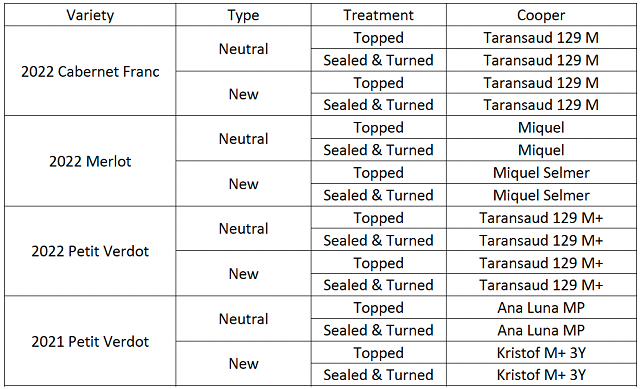
Table 1: Four lots were included in the experiment. One new and one neutral barrel was included for each treatment for each lot.
Methods
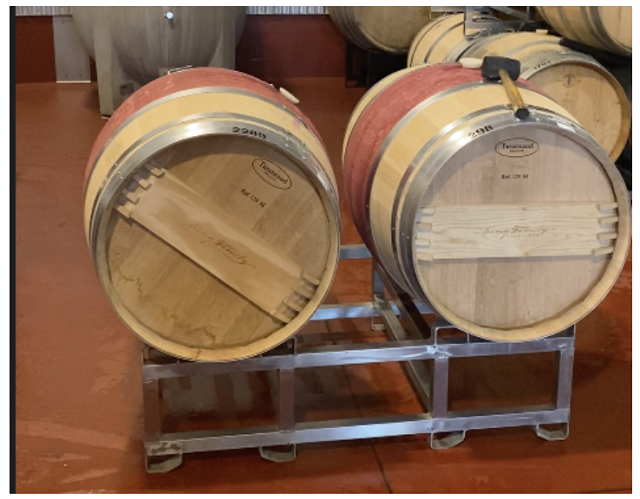
There were 4 lots of wine used in this experiment, one lot each of Cabernet Franc and Merlot, and two lots of Petit Verdot. There were four barrels of wine per lot, two new barrels of the same cooper and type and two used barrels of the same cooper and type (Table 1). Each “pair” (one sealed, one turned) was stored on the same barrel rack to ensure similar environmental conditions (humidity, airflow, temperature) (Figure 1).
Figure 1: After topping and sealing with a silicon bung, one barrel per pair was turned and remained sealed while the other barrel was topped monthly.
For each lot, wine underwent processing and alcoholic fermentation according to the standard protocol of the winery. After the completion of fermentation, free run wine was separated from must and allowed to settle in tank before transfer to barrels for malolactic fermentation. Malolactic fermentation occurred in barrel without inoculation. Wine was not racked post-malolactic fermentation. See Appendix A for more details on winemaking operations.
At the completion of malolactic fermentation, SO2 and Stab Micro M additions were made, then the barrels were topped. For each pair of barrels:
- A control barrel was stored upright, sealed with a silicon bung, topped roughly once per month. Topping volume was recorded each time the barrel was topped. No adjustments were made to SO2 during aging.
- A treatment barrel was sealed with a silicon bung then turned to a 45° angle using a barrel turning tool (click here to see a video). These barrels remained sealed and were not topped during the course of the aging time (November 21 to May 30).
On May 30th (after 6 months of aging), barrels were unsealed. Dissolved oxygen was measured for each barrel immediately after bungs were pulled. Wine chemistry was measured for all barrels. Acetaldehyde was measured for the Cabernet Franc barrels only. The winemaker and cellar personnel tasted the wines together. Cabernet Franc wine from neutral barrels was chosen for blind sensory analysis at a WRE sensory session. After sampling and tasting, all barrels (including turned barrels) were topped. The volume of wine lost during aging was deduced based on the total amount of topping wine used for each barrel.
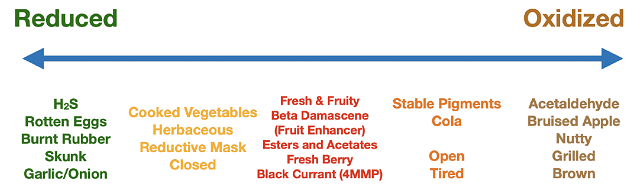
Sensory analysis of Cabernet Franc aged in turned vs. topped barrels was completed by a panel of 28 wine producers. Wines from neutral barrels were presented blind in randomly numbered glasses. Tasters were presented with three wines, two of one type and one of the other, and asked to identify which wine was different (a triangle test). To account for order effects, there were four tasting groups with the unique wine in the triangle test balanced between groups. Tasters were then asked to score each wine on a scale of 0 to 10 for its place on the spectrum of oxidative characteristics (Figure 2), fruit intensity, fruit character and astringency. They were also given open ended questions to describe the wines. Results for the triangle test were analyzed using a one-tailed Z test. Descriptive scores were analyzed using repeated measures ANOVA. Lastly, tasters were given 4 different fabrics as tactile standards (in order from softest to roughest; soft suede, velvet, sandpaper, and burlap) and were asked to select the fabric that most closely represented the astringency of the wine. Fabrics were chosen to include an increasingly rough tactile perception.
Figure 2: A spectrum of oxidative characteristics was defined for use in sensory analysis.
Results
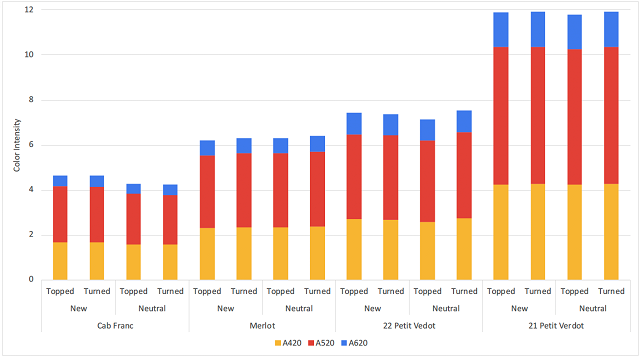
Each of the wine lots began the experiment with very similar wine chemistry (Table 2, Appendix B) and color intensity (Figure 3) between paired barrels. These similarities persisted after 6 months of aging (Appendix C).
Table 2: Initial (post-malolactic) wine chemistry of four barrels of Cabernet Franc before turning (November 21, 2022) (ICV Labs). Initial chemistry for other trial varieties can be found in Appendix A.
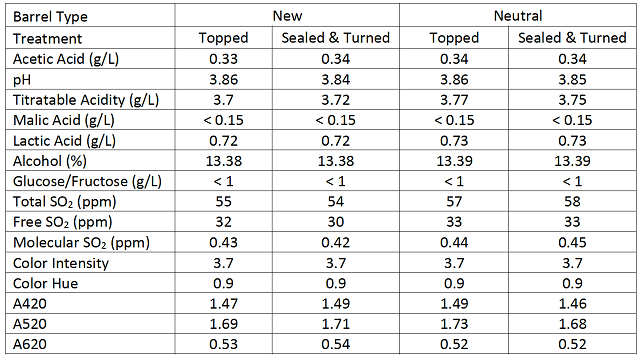
Figure 3: Initial color intensity of four wines before barrel turning (ICV Labs, Nov 2022)
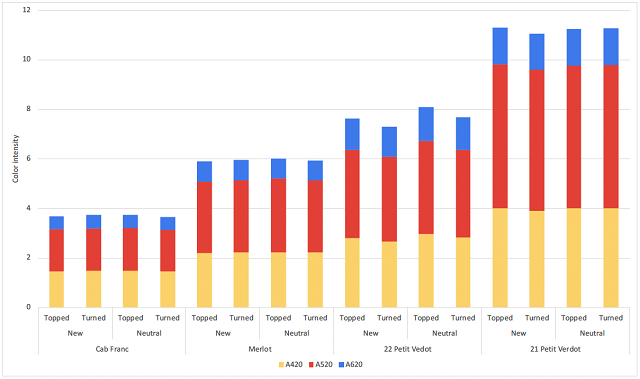
Oxygen related metrics including free and total SO2, acetic acid and acetaldehyde were nearly identical in all lots (Table 3, Figure 4), as was color intensity (Figure 5).
Table 3: Post-aging wine chemistry of topped vs. sealed & turned barrels (May 30, ICV Labs)
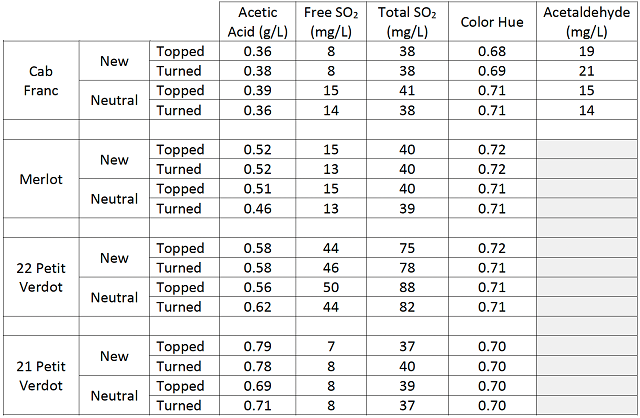
Figure 4: Post-aging SO2 chemistry for four lots of wine. Endcaps provide free SO2 values
(ICV Labs, May 2023)
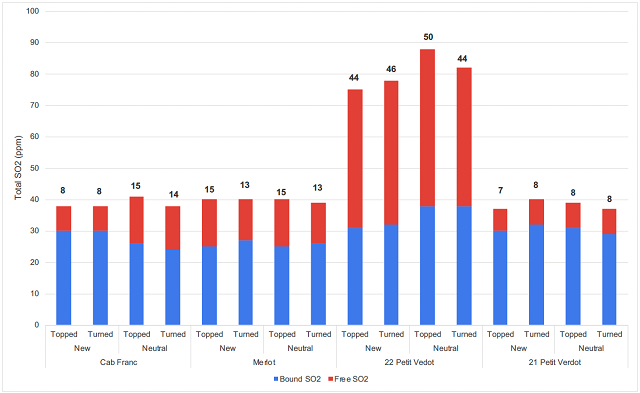
Figure 5: Color intensity of four wines after 6 months of aging in upright vs. turned barrels
(ICV Labs, May 2023)
The total volume of topping wine used was measured and recorded throughout the aging period for the upright barrels, and at the end of the aging period for the turned barrels. Overall, between 1-2.5% of the barrel volume was lost during this time, well within values reported in the literature. Ribereau-Gayon et al (2006) report annual losses at a rate of 4-5% while Del Alamo-Sanza and Nevares (2018) report losses of 2-5 liters (0.8 – 2.2% in a 225 liter barrel). There were no consistent differences in total topping amount (i.e. volume loss) between treatments, meaning the same amount of wine was lost regardless of whether the barrel was topped or sealed and turned. The differences between physical structure of the barrels was more likely to be causing differences in evaporation rates.
Figure 6: Barrel topping volume shown as a percentage of the overall barrel volume. Data labels indicate the year the barrel was new as well as treatment. Ex: 21 T indicates a barrel from 2021 that was topped. 21 S indicates a sealed barrel. Endcaps indicate dissolved oxygen (mg/L) values of wine in barrel at the end of the aging period
(in-house data)
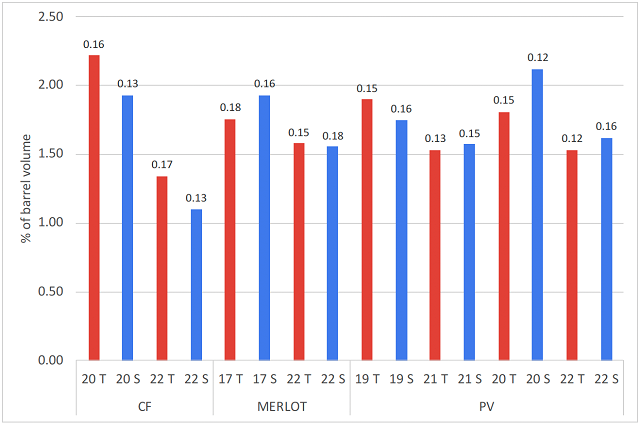
Contrary to expectations, new barrels did not require more topping wine than older barrels. Topping volumes for this experiment were not recorded until after malolactic fermentation had finished. The additional volume of wine expected to be needed for new barrels had likely already been absorbed into barrel staves before measurements began.
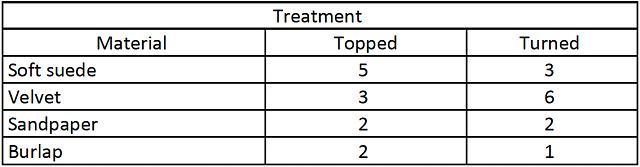
In a triangle test comparing Cabernet Franc aged in topped vs. sealed & turned barrels, 12 out of 28 respondents were able to distinguish which wine was different, indicating the wines were not significantly different (Z=-0.87, p= 0.19). There were also no significant differences in scores for any of the descriptors (Table 4). When asked to compare the astringency of wine to 4 different tactile fabrics, the highest number (5 tasters) selected soft suede to describe the control wine and in the turned wine the highest selection was velvet with 6 tasters (Table 5), indicating wine stored in turned barrels may have been slightly more astringent.
Table 4: Repeated measures ANOVA comparing descriptive scores for Cabernet Franc stored in topped vs. turned barrels
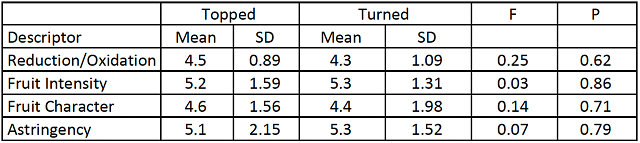
Table 5: Astringency scores for Cabernet Franc stored in topped vs. turned barrels
References
(1) Jackson, R. S. Wine Science: Principles and Applications, 4th edition.; Academic Press: Amsterdam, 2014.
(2) Ribereau-Gayon, P.; Glories, Y.; Maujean, A.; Dubourdieu, D. Handbook of Enology Volume 2: The Chemistry of Wine Stabilization and Treatments, 2nd ed.; John Wiley & Sons, Ltd: West Sussex, England, 2006; Vol. 2.
(3) Del Alamo-Sanza, M.; Nevares, I. Oak Wine Barrel as an Active Vessel: A Critical Review of Past and Current Knowledge. Critical Reviews in Food Science and Nutrition 2018, 58 (16), 2711–2726.
Appendix A: Winemaking methodology for four lots of wine prior to barrel turning
Cabernet Franc
Cabernet Franc grapes (4.27 tons) were hand harvested from the King Family A214 block on 9/29/22, chilled overnight, then destemmed without crushing to concrete tank for fermentation. Fermentation was inoculated with 12 g/hL Excellence XR Yeast (Lamothe Abiet). Cap management occurred twice daily with once daily fermentation monitoring until 10/17/22. Free run wine was drained and must was pressed on 10/31/22. Wine was allowed to settle for a full day before transfer to barrels for malolactic fermentation (without inoculation). Malolactic fermentation was complete by 11/11/22, when 70 mg/L SO2 and 3.33 g/hL Stab Micro M were added to each barrel. Tartaric acid (1 g/L) was added on 11/21/21. At this time, two pairs of barrels were chosen for experimentation, one pair of older (2020) barrels and one pair of new (2022) barrels (Table 1).
Merlot
Merlot grapes (5.79 tons) were hand harvested from King Family Vineyards Fidelis Farm R3 on 9/28/22, chilled overnight, then destemmed into tank without crushing with the addition of 41 g SO2 (11 mg/L) on 9/29/22. Fermentation was inoculated with 10 g/hL Excellence XR Yeast (Lamothe Abiet). Cap management occurred twice daily with once daily fermentation monitoring. Sugar (5 g/L) and Lafase HE Grand Cru enzyme (3 g/hL) were added on 10/1/22. Additional yeast (Excellence XR, 10 g/hL) was added on 10/4/22. Fermoplus 1er Cru complex yeast nutrient (AEB, 15 g/hL) was added on 10/6/22. Fermentation progressed until 10/17. Wine was drained and pressed on 10/26, allowed to settle in tank overnight, then transferred to barrels for malolactic fermentation on 10/27/22. Malolactic fermentation was complete by 11/14/23, when 70 mg/L SO2and 3.33 g/hL Stab Micro M were added to each barrel. At this time, two pairs of barrels were chosen for experimentation, one pair of older (2017) barrels and one pair of new (2022) barrels (Table 1).
2022 Petit Verdot (PVB)
Petit Verdot grapes (4.7 tons) were hand harvested from King Family Vineyards PVB Block on 9/30/22, chilled overnight, then destemmed into tank without crushing with the addition of 70 g (24 ppm) SO2 on 10/1/22. Fermentation was inoculated with 12 g/hL D254 Yeast (Scottlabs). Cap management occurred twice daily with once daily fermentation monitoring. An additional 10 g/hL D254 yeast was added on 10/4. Fermoplus 1er Cru complex yeast nutrient (AEB, 15 g/hL) was added on 10/06/22. Fermentation progressed until 10/17/22. Wine was drained and pressed on 11/1/22, allowed to settle in tank overnight, then transferred into barrels for malolactic fermentation on 11/2/22. Malolactic fermentation was complete by 11/11/22, when 70 g/hL SO2 and 3.33 g/hL Stab Micro M were added to each barrel. Tartaric acid (2.5 g/L) was added on 11/21/22 before barrels were turned. At this time, two pairs of barrels were chosen for experimentation, one pair of older (2020) barrels and one pair of new (2022) barrels (Table 1).
2021 Petit Verdot
Wine was blended and transferred to barrel on 8/3/22. Wine was aged in barrels and topped according to the SOP of the winery until the beginning of the experiment in November. At that time, wine was taken for analysis to ensure wine had similar chemistry at the beginning of the experiment. At this time, two pairs of barrels were chosen for experimentation, one pair of older (2019) barrels and one pair of newer (2021) barrels (Table 1).
Appendix B: General Chemistry post malolactic fermentation, before turning for Merlot and Petit Verdot wines (November 21, 2022) (ICV Labs).
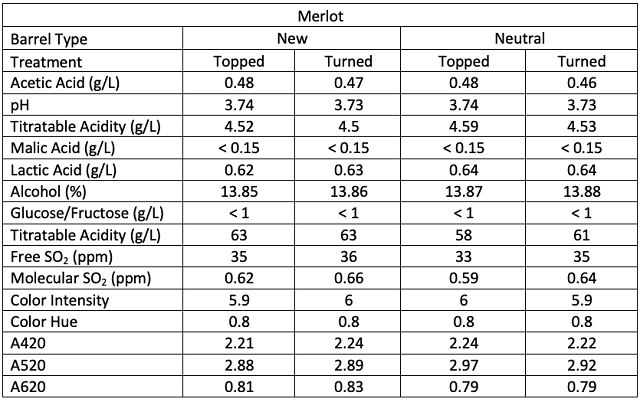
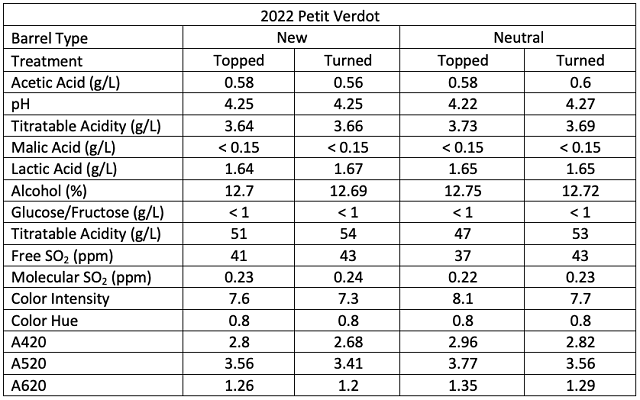
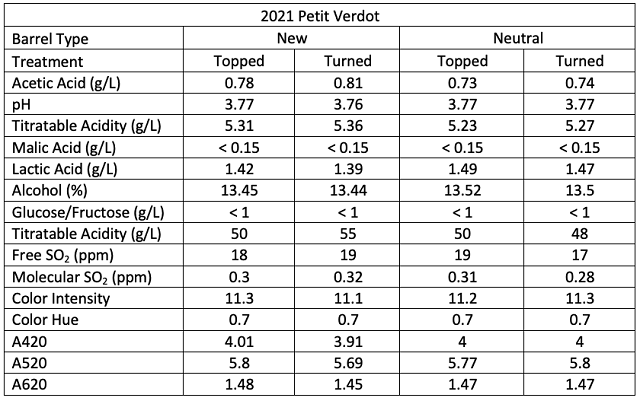
Appendix C: General Chemistry after 6 months of aging in upright vs. turned barrels (May 30, 2023) (ICV Labs).


