Practical exercises for sensory training with standards
Dr. Beth Chang, Virginia Tech Enology Extension Specialist
Just as we would calibrate a pH meter with buffer solutions before using, it can be helpful to calibrate our palates on a regular basis (a few times per year) or before evaluating wine samples for blending, writing tasting notes, etc. So how would we go about doing this? Here’s some simple steps and tips:
General
- Don’t go it alone. We all have different anosmias (things we are nose-blind to), different numbers and types of odor and taste receptors, different sensory memories, and simply different preferences! Working with a partner or team can help to overcome these biases and reach more consistent results. Plus, sensory training can be a good team building activity!
- Have a “vanilla ice cream” of wine…. Or maybe a whole Neapolitan-esque flight! Again, just as we calibrate the pH meter using 2-3 buffer solutions, it is helpful to have a standard wine (or wines) that are consistently used for tuning up your sensory perceptions and to act as a reference for spiked samples. The best house-reference will a wine that is easily available, free of faults, and a good example of the type of wine you will be evaluating1,2.
- Gather ingredients for making standards i.e. go grocery shopping! The following recommendations come from “Wine sensory reference standards align wine taster on a shared terminology” by Jennifer Sela Bowen and her colleagues3. These are not set in stone; gather materials that you think will represent the wines you will be using for your training or analysis. You may choose to only make some of these, or focus on one category at a time, then systematically rotating through these 1-2 times per year. For example, focus on fruit and floral in one training session, vegetal and earthy in the next session.
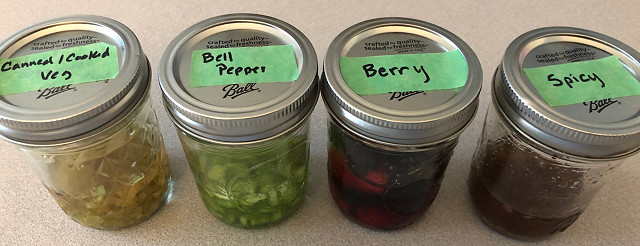
Prepare standards: The idea here is to get the odorants into a form they will easily perceptible during training:
- Chop, crush, slice, toast standards as needed.
- To concentrate and contain aromas, and facilitate multiple people accessing them, it may help to place a quantity (typically a few tsps. to tbsps.) of each standard in a Mason jar with a lid.
- To closer replicate the wine matrix, add 1⁄4 c water and 1⁄2 tsp. vodka or other neutral spirit. You can also use a neutral wine base, free of faults with low aromatic intensity1. Grocery store box wine is one option.
- As you would with blending formulations, we highly recommend writing down quantity (or percentage) used! This will allow you to replicate your standards from session to session even if you alter the original recipe to better fit your house definition of terms.
After you have prepared your standards, here are a few activities you can do with them:
Activity #1 Use standards to define a set of terms for your in-house wines
- Define your question. Are you trying to characterize all the aromas in Cabernet Franc? Are you trying to describe what makes one vineyard’s Petit Verdot different than another? With this question, determine which group of wines you will eventually be evaluating.
- Smell and taste your standard wine(s), and individually generate a complete list of descriptors. This many be your base (“vanilla”) wine or the whole group of wines you wish to characterize, depending on the question you are asking.
- Compare descriptors with your team to form a large list.
- Refine your list:
- Remove hedonic terms, those that have a value judgement about the wine (great, terrible) and subjective terms, those you could never make a standard for (round, masculine)
- See if any of the terms could be more specific. If not that is OK, but do ask.
- See if any of the terms are redundant, with different team members using different words for the same odors. See if you can form a consensus around one term.
- Grouping similar descriptors together, e.g. raspberry and red berry, may help evaluate specificity and redundancy.
- Smell the standards that correlate to your descriptors.
- If you have a lot of standards, cleansing your nose by smelling coffee beans or even the inside of your arm will refresh your sense of smell.
- If you have mixed your standards in a base wine (rather than water or spirits), smelling the base wine periodically helps highlight the effect of that odorant on the wine in general.
- Discuss with your team:
- How closely does what you smell correlate with the descriptor and the actual odor in the wine?
- Are there additional terms that need to be added to your description?
- Are there additional standards you need to make? How would you make them? (Make these and record the recipe)
- Do any of your standard formulations need to be tweaked? If so, feel free to make that change, just make sure to write down how to make the improved standard.
- The goal of this evaluation is not to reach a “right” answer, but to work toward a team consensus about what a given word choice, e.g. red fruit, encompasses and have an in-house reference standard (formulation) that roughly approximates the terminology, e.g. 4 smashed raspberries + 1 canned cherry in ¼ c water. The simple act of putting words and standards to what you are smelling and tasting will help improve your sensory expertise
- After calibrating with your standard wine(s), repeat Steps 5-8 with the in-house wines which you seek to evaluate.
Other suggested activities:
- For simple odor recognition activities, The Wine Aroma wheel is a great place to start. The Wine Aroma Wheel website offers a downloadable how-to guide for beginners that would be great to use with beginners or as part of a tasting room experience. These activities can easily be focused around more specific terms for use in training more experienced tasters.
- In “The University Wine Course”, Marian Baldy shares a number of activities she used to use with her wine appreciation classes at UC Davis. She includes chapters on sensory analysis of white and red wines complete with worksheets. Appendix D includes step by step instructions for setting up these labs at home. They make great training exercises.
- For more focused work, consult published papers in sensory science for lexicons and standards, then apply them to you own wines. For example, to evaluate your own Viognier, perhaps use the standards found in “Descriptive Analysis and Consumer Study of Viognier Wines from Virginia, France and California”, a study funded by the Wine Board. After you memorize the terms and the reference standards, evaluate your own Viognier and perhaps some from your neighbors. Smelling and tasting your own wine blind in the company of others may give you valuable insights.
*Suggested grocery store standards from Sela Bowen et al (2018)
References
(1) Noble, A. C.; Arnold, R. A.; Masuda, B. M.; Pecore, S. D. Progress Towards a Standardized System of Wine Aroma Terminology. American Journal of Enology and Viticulture 1984, 35 (2), 107–109.
(2) Noble, A. C.; Arnold, R. A.; Buechsenstein, J.; Leach, E. J.; Schmidt, J. O. Modification of a Standardized System of Wine Aroma Terminology. American Journal of Enology and Viticulture 1987, 38 (2), 143–146.
(3) Bowen, J. T. S.; Cantu, A.; Lestringant, P.; Sokolowsky, M.; Heymann, H. Wine Sensory Reference Standards to Align Wine Tasters on a Shared Terminology. Catalyst: Discovery into Practice 2018, 2 (2), 42–49.

